Sudoku Strategies: Bi-Value Universal Grave
Understanding the Bi-Value Universal Grave (BUG) Strategy
The Bi-Value Universal Grave (BUG) is not a standard, self-contained Sudoku solving technique in itself, but rather a configuration of candidates that implies a puzzle either has no unique solution or can be solved using uniqueness logic. A proper Sudoku puzzle is defined as having only one solution. The "strategy" is used to avoid creating a BUG pattern, which allows deductions in puzzles assumed to have a unique solution.
The most common application of this principle is the BUG+1 scenario.
What is a BUG Pattern?
A pure BUG pattern is a state in a Sudoku puzzle where:
- Every single unsolved cell has exactly two possible candidates remaining.
- There are no "hidden singles" anywhere in the grid (i.e., every candidate value appears at least twice within each row, column, and 3x3 box it appears in).
If a puzzle reaches this state, it is "fatally flawed" because it will have at least two valid solutions (a "deadly pattern"). The choices are all interchangeable, and there is no logical way to proceed without guessing.
The BUG+1 Solving Strategy
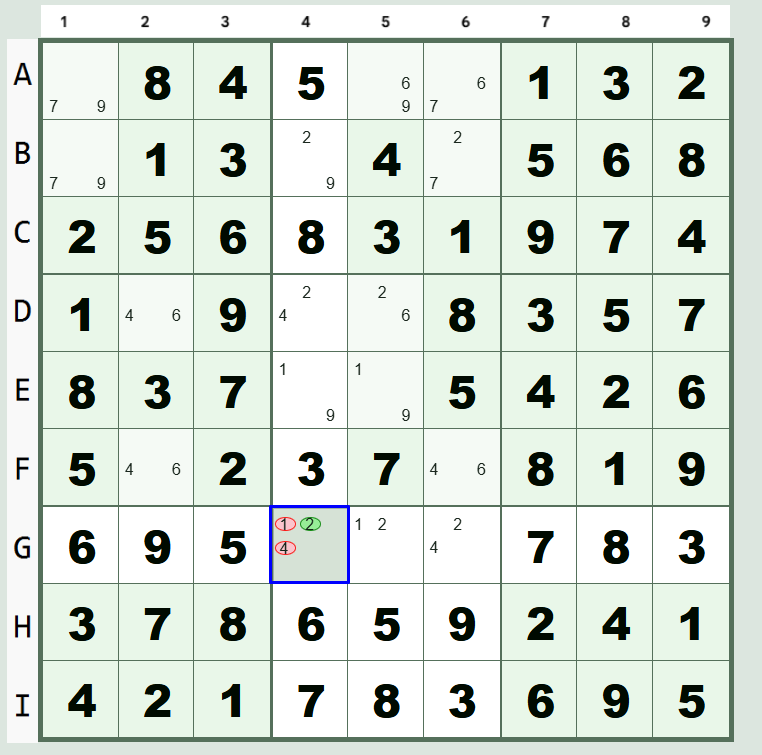
The BUG+1 technique is a powerful, advanced strategy that applies when your grid is in a "nearly BUG" state.
Conditions for BUG+1:
- All unsolved cells except one contain exactly two candidates.
- One single "focal" cell contains exactly three candidates.
- The puzzle must be assumed to have a unique solution (standard for most published Sudokus).
How to Apply the BUG+1 Strategy:
The logic is based on the principle that the grid *cannot* be allowed to devolve into a pure BUG (all bi-value cells).
- Identify the Focal Cell: Locate the single cell with three candidates.
- Analyze Candidates: Examine the three possible candidates within that focal cell.
-
Find the "Odd One Out": Determine which of the three candidates appears three times across the three "houses" it belongs to (its row, its column, and its 3x3 box).
- The other two candidates will appear exactly twice in those houses, forming part of a potential "deadly pattern".
- Make the Placement: The candidate that appears three times must be the correct solution for that cell. Placing this value prevents the formation of the invalid, non-unique BUG pattern.
- Solve: Placing this number often triggers a cascade of singles and allows the rest of the puzzle to be solved easily.
Example Logic
If you are in a BUG+1 situation and you choose one of the "twice-appearing" candidates for the focal cell, you effectively reduce the entire grid to a pure BUG state. This invalidates the puzzle's uniqueness assumption. Therefore, to preserve the puzzle's validity, the only possible value for the focal cell is the candidate that appears three times.